KULIMO — Services
More Leads: Your Website Should Work as Hard as You Do
Conversion rate optimization means turning the visitors you already have into more inquiries, before you spend a single extra euro on advertising. KULIMO designs and builds websites and landing pages around this goal: a clear message, visible trust, fast load times, and an inquiry path with no hurdles. Visitors become inquiries, and inquiries become loyal customers. Measurably, not by gut feeling.

Conversion rate optimization Berlin: the essentials at a glance
This page shows how we approach conversion rate optimization, from the typical reasons inquiries don’t come in to load time and costs to the metrics that prove success.
Why inquiries don’t come in
Six causes we find in almost every audit.
Our mental model
Understand, trust, act, return.
The building blocks
What sets high-converting websites apart, technically and structurally.
Load time
Why conversion rate optimization starts with the Core Web Vitals.
Costs and benefits
What drives the effort, and what it saves.
Metrics
Four numbers that show whether conversion rate optimization is working.
Why websites don’t generate inquiries
Most websites don’t fail for lack of visitors but because of what visitors experience there. In audits, we keep seeing the same conversion killers:
The message is unclear.
If visitors don’t understand within the first few seconds what you offer, who it’s for, and why they should choose you, they don’t scroll. They leave.
Trust is invisible.
No case studies, no real project photos, no contact people, no reviews. Visitors don’t buy design; they buy confidence.
The site is too slow.
Every second of load time costs visitors, on mobile first. Performance isn’t a technical footnote; it’s the number one conversion factor.
The next step is hidden.
Three different buttons, five competing offers, and the contact form buried in the footer. Try to get everything at once, and you get nothing.
The form is an obstacle.
Eight required fields for a simple inquiry, no hint about what happens next, and no alternative like appointment booking or WhatsApp.
Nobody is measuring.
Without clean measurement, nobody knows where visitors drop off, and “optimization” remains guesswork.
Every one of these issues can be fixed. That’s exactly what we do.
From visitors to inquiries to customers: how we think about conversion
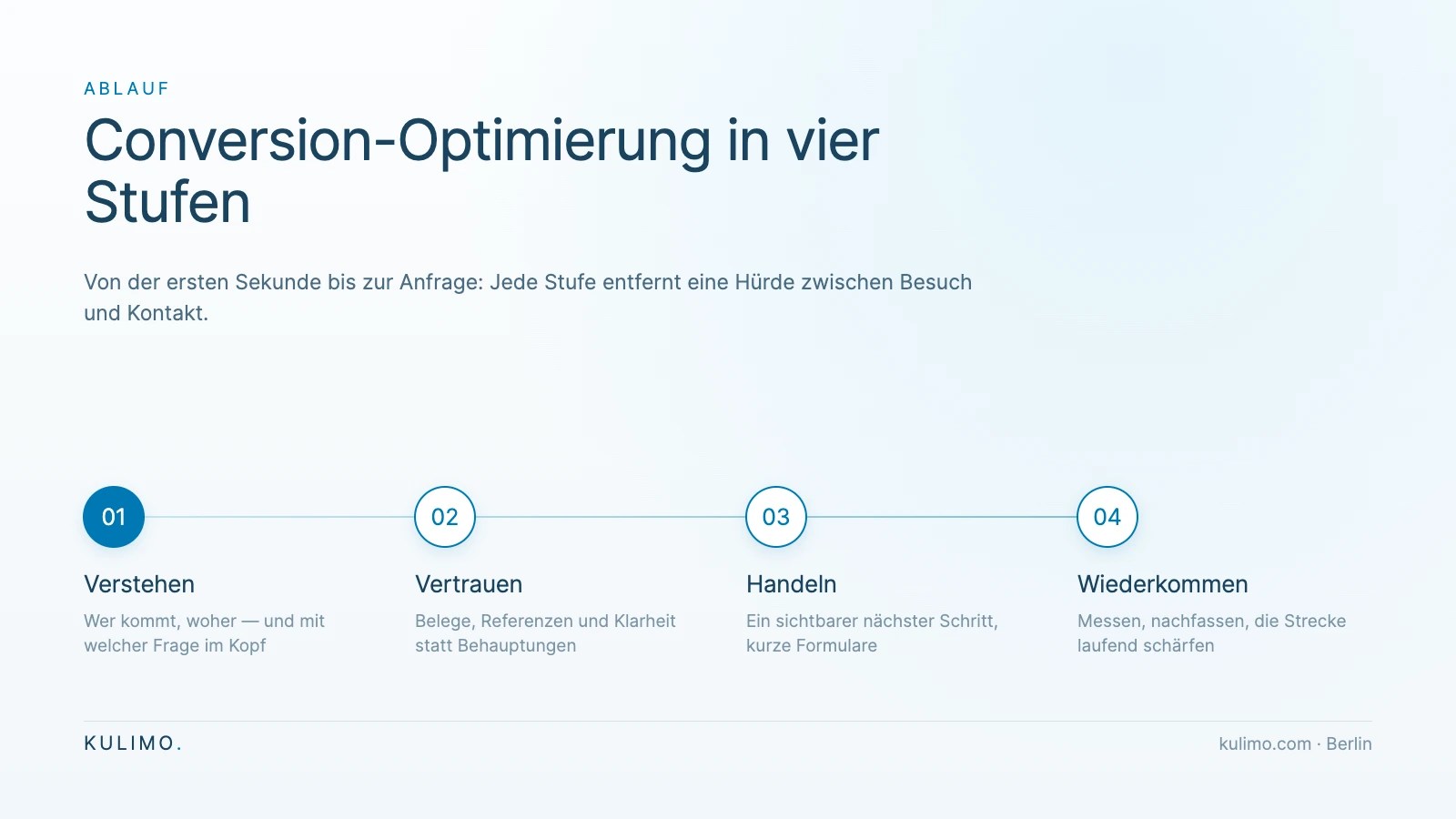
Conversion isn’t a button in a different color. It’s a chain, and it breaks at its weakest link:
Understand
Within a few seconds, it has to be clear what you offer, who it’s for, and what sets you apart. We write your message from the customer’s point of view, not the company’s.
Trust
Real projects, real faces, real reviews, clear contact people. Trust comes from proof, which is why we work exclusively with genuine evidence rather than claims.
Act
One clear next step per section: book an appointment, send an inquiry, request a callback. Short forms, transparent expectations (“response within one business day”), and mobile usability with one thumb.
Return
The first inquiry is just the beginning. Clean handoffs into your processes (appointment booking, CRM, email) turn one-time inquiries into repeat customers.
One principle always applies: we optimize without dark patterns. No artificial time pressure, no hidden checkboxes, no manipulative countdown timers. What converts under pressure gets canceled just as predictably. Sustainable conversion comes from clarity and trust.
The building blocks of high-converting websites
Conversion architecture
Every page has one primary goal and one clear call to action per screen. Secondary paths (email, phone, WhatsApp) stay accessible without competing.
Load time & Core Web Vitals
We develop performance-first: optimized images, lean code, fast server responses. Speed is the only conversion factor that works on every page at once.
Trust architecture
Case studies, reviews, certifications, and contact people are placed where doubts arise: next to the form, before the pricing conversation, not somewhere in the footer.
Forms & appointment booking
As short as possible, as clear as necessary: few fields, understandable error messages, BFSG (German Accessibility Strengthening Act) accessibility, and direct online booking as an alternative for anyone who’d rather not write.
Mobile first
Most of your visitors come from smartphones. Thumb-friendly buttons, tappable phone numbers, no layout shifts.
Measurability
GDPR-compliant tracking of the steps that matter: page view → scroll → form start → inquiry. That shows us where the chain breaks, and we fix exactly that.

Landing pages for campaigns
Sending Google Ads or social campaigns to your homepage burns budget. A landing page has exactly one job: to deliver on the ad’s promise, with one message, one offer, and one call to action.
We plan, design, and build landing pages that match the campaign: a consistent message from ad to form, fast load times on mobile too, and clean measurement all the way to the inquiry. Available in variants on request, so you can test what really converts better instead of guessing.
Measure, don’t guess
Honesty is part of optimization: A/B tests need traffic. If you have a few hundred visitors a month, a split test won’t give you a reliable answer, and anyone who sells you “data-driven A/B testing” at that point is selling theater.
That’s why we work in stages:
With low traffic
A conversion audit against proven principles, user tests with real people, and form and load time analysis. That finds the big leaks, without statistical theater.
With growing traffic
Event tracking along the inquiry funnel, analysis by device and channel, and targeted improvement of the weakest point.
With high traffic
Real A/B tests of individual elements (headlines, forms, offer presentation) with clean analysis and documented results.
Everything GDPR-compliant, with no sprawling data sharing, and with consent management that doesn’t itself become a conversion killer.

More leads beyond your website: Leads Radar
A high-converting website waits for visitors. Sometimes it’s smarter not to wait.
We built Leads Radar as our own tool that works in the other direction: you define your ideal customer profile, and the system searches markets and regions for matching companies and delivers a prioritized list of promising business customers.
Website conversion and active lead generation complement each other: the website turns interest into inquiries, and Leads Radar makes sure interest isn’t left to chance in the first place. Together, they form a sales system, not just hoping for Google.
What we check in the audit before we change anything
We don’t start with a design but with an assessment. We go through these eight points for every website, and they almost always explain where the inquiries are being lost.
Entry pages
Which pages do visitors actually land on? Often it’s not the homepage but a subpage that was never meant for first contact.
The first screen
Is it clear within the first few seconds what this is about, who the offer is for, and what the next step would be?
Load time and stability
Measured on a mobile connection, not on the office Wi-Fi. That’s the difference between lab values and reality.
The path to the form
How many clicks lie between entry and inquiry, and is it clear at every step why it’s worth continuing?
Form structure
Number of required fields, field types, error messages, and the confirmation after submitting.
Proof and case studies
Is evidence placed where doubts arise, or collected on a subpage hardly anyone opens?
Measurement points
Is what matters even being tracked? Without clean measurement, any conversion rate optimization remains a guess.
Mobile cross-check
The same journey again on a phone. This is usually where the biggest difference shows up.
Conversion rate optimization starts with load time
Before copy can persuade, it has to be visible. That’s why speed isn’t a technical detail but the first lever of any conversion rate optimization.
The first two seconds
On mobile connections, whether someone stays is decided early. Every additional second costs inquiries, before your offer has even been read. Conversion rate optimization without performance work leaves potential on the table right here.
Core Web Vitals as the benchmark
Load time, responsiveness, and layout stability are measurable. Google publishes the reference values at web.dev — they’re both a ranking factor and a conversion factor.
Shifting layouts cost clicks
When content shifts while loading, people misclick and give up. So conversion rate optimization also means fixed image dimensions, calm pages, and no late-loading surprises.
Making trust visible: the underrated part of conversion rate optimization
Most websites explain well what they offer. What’s missing is proof. That’s exactly where conversion rate optimization comes in once the technology is right.
Results, not adjectives
“Reliable” and “innovative” appear on every other website. A concrete number, a named project, or a verifiable time frame is far more powerful. Conversion rate optimization replaces claims with evidence.
Faces and names
People hire people. A real team photo with names and responsibilities noticeably lowers the barrier, especially for services that need explaining.
Case studies in the right place
A case study works where doubt arises: next to the price, next to the form, next to the claim that needs backing up. In conversion rate optimization, placement matters more than quantity.
Easy to reach
Phone number, address, and contact person visible on every page. If people have to search first, they won’t inquire.
Content that actually helps
Pages that truly answer a question build trust and get found more easily at the same time. Google’s guide to creating helpful content describes the criteria for this.
Conversion rate optimization on smartphones
For most of our clients, the majority of visits come from mobile, but the majority of inquiries come from desktop. That gap is the most rewarding starting point for conversion rate optimization.
Usable with one thumb
Important buttons belong in the lower part of the screen, not at the top edge. Large tap targets with enough spacing prevent misclicks, a detail that’s regularly underestimated in conversion rate optimization.
The right keyboard for each field
A phone field should open the number pad, an email field the matching keyboard. Small things like this noticeably speed up filling in forms and reduce drop-offs.
Call instead of type
On a phone, the phone number is the shortest path to an inquiry. Placed as a tappable link, it becomes the most effective button on the entire page.
That’s why we review mobile journeys separately: separate measurement, separate analysis, separate measures. Conversion rate optimization that only happens on the big screen improves the experience for the smaller half of your visitors.
What conversion rate optimization costs, and what it saves
Conversion rate optimization pays off differently from advertising: you pay once for an improvement that then works on every visit.
Scope of the funnel
A single landing page can be reworked quickly. Full conversion rate optimization across the homepage, service pages, and form is a different project, but it works at every point.
Available data
If numbers already exist, we start with analysis. If measurement is missing, it’s part of the first step: conversion rate optimization without baseline values can’t be proven later.
State of the technology
On a cleanly built site, changes take a matter of hours. On convoluted site-builder pages, the same adjustment costs many times more.
The most honest comparison isn’t the price but the cost per inquiry. If conversion rate optimization raises your conversion rate from one to two percent, the cost of every inquiry is cut in half at the same ad budget, permanently and without higher click costs.
Five mistakes that make conversion rate optimization ineffective
We see these patterns in almost every audit. Avoid them, and you get to results without detours.
Changing everything at once
If copy, layout, and form all change at the same time, you won’t know afterward what worked. Conversion rate optimization depends on being able to separate cause and effect.
Deciding by personal taste
Opinions in the meeting room are no substitute for data. Conversion rate optimization asks what visitors actually do, not which version people internally like better.
Looking only at the homepage
Most inquiries come from service pages, not the homepage. Conversion rate optimization has to follow the path people actually take.
Never touching the form
Every additional required field costs conversions. Hardly any change in conversion rate optimization is as quick to implement and as effective as a shorter form.
Stopping after the relaunch
Markets, offers, and expectations change. Conversion rate optimization isn’t a project with an end date but a routine with fixed measurement points.
Conversion rate optimization metrics
Conversion rate optimization isn’t a matter of taste. Four numbers show whether the work is paying off in everyday business.
Conversion rate
The share of visits that turn into an inquiry. The central number of any conversion rate optimization, always best viewed separately by page and device.
Form drop-off point
At which field do people give up? That one insight often does more for conversion rate optimization than any design debate.
Inquiry quality
More inquiries are of little use if they aren’t a good fit. Good conversion rate optimization increases the share of contacts that match your offering.
Trust and time on page
Proof, case studies, and clear statements have a measurable effect. The Nielsen Norman Group has studied the fundamentals in depth.
FAQ
Frequently asked questions about conversion rate optimization
What exactly does conversion rate optimization mean?
All measures that turn existing website visitors into more inquiries, bookings, or purchases: clearer messaging, visible trust, faster load times, simpler forms, and clean measurement. In short: serve the visitors you already have better, before you pay for new ones.
How can I tell my website is losing inquiries?
Typical signs: lots of visitors but hardly any inquiries; high bounce rates on mobile; forms that get started but not submitted; calls with questions the website should have answered long ago. A conversion audit makes these leaks visible.
Do I need a new website for this?
Not necessarily. Targeted changes to messaging, forms, load time, and trust elements often deliver significant improvements on your existing site. Whether optimization is enough or a relaunch makes more sense is something we clarify in the audit: honestly, not driven by sales.
What’s the difference between a landing page and my homepage?
The homepage has to serve many audiences and paths. A landing page has exactly one job: a specific offer for a specific audience, usually as the destination of a campaign. That’s why it converts better than any homepage.
Do you do A/B testing?
Yes, if your traffic delivers reliable results. Below that, it would be statistical theater, and we’ll tell you so openly. For smaller sites, we work with audits, user tests, and proven principles that work even without test volume.
Is the tracking GDPR-compliant?
Yes. We measure the inquiry funnel with privacy-compliant tools, clean consent management, and no unnecessary data sharing. Measurability and data protection aren’t mutually exclusive; poor implementation is the problem.
Do you use artificial time pressure, countdowns, or similar tricks?
No. Dark patterns generate short-term clicks and long-term damage to trust: cancellations, complaints, bad reviews. We optimize with clarity, proof, and simple paths. That converts more sustainably.
What do the costs depend on?
On the scope: a single landing page, optimization of your existing website, or an end-to-end conversion system with measurement and support. After the intro call, you receive a fixed-price quote with no hidden line items.
How quickly does conversion rate optimization show results?
Technical improvements like load time or a shorter form take effect immediately. Meaningful numbers take two to eight weeks, depending on traffic volume. So conversion rate optimization delivers noticeable effects early, but reliable proof only after a few weeks.
Does conversion rate optimization work with low traffic?
Yes, just with different methods. Instead of A/B tests, we work with an audit, user observation, and best practices. Conversion rate optimization with low traffic means removing obvious obstacles rather than waiting for statistically sound tests.
Do we have to rewrite our copy for conversion rate optimization?
Not entirely. Often it’s enough to change the order: benefits up front, proof right next to them, and the next step clearly visible. Conversion rate optimization is more often a question of structure than of wording.
How are conversion rate optimization and SEO connected?
SEO brings people to your site; conversion rate optimization makes sure they turn into inquiries. The two go hand in hand: fast load times, clear structure, and content that truly answers a question improve both rankings and conversion rate at the same time. If you only work on one of them, you give away half the effect.
What do you need from us to get started?
Access to your website analytics, if available, and a conversation of about an hour about your typical customers and inquiries. Nothing more. We gather everything else ourselves, and the first findings are usually ready within two weeks.
Let’s find your weakest point
In the intro call, we look at your website together and identify the one spot where you’re currently losing the most inquiries. No obligation, concrete, and no sales pressure.